|
The
White Rock An extract from the Book |
|
"to read the road-system of the Incas is to read a different language from our own." |
|
|
|
Up to
now we had been following traces of Inca road, immaculately laid stonework,
as it elusively traced its way across the landscape, sometimes disappearing
completely, then re-appearing over precisely the stretch one needed it most
with the intuitive Inca sense for the mountains. Inca roads are like
magic writing. Over the years since that first journey, I’ve noticed how you
can be at the top of a pass and see nothing – but a slight change of angle, a
difference in the light, the mist moving across a rock-face and you suddenly
see a line traversing a ridge, usually unnaturally high. The Incas liked the
heights. The Quechua guides I’ve worked with always travel instinctively on
the high side of any given valley, while the natural tendency of European or
American mountain trekkers is to keep to the bottom if they can. Ever since Bingham
made the endearing mistake of coming here in February on his very first
expedition in 1909 and so found himself in the middle of the torrential rainy
season, explorers have naturally come in the dry, winter season (April to
November). Because of this, they have often misunderstood why the Incas built
so high on valley walls. In wet season conditions, they would immediately see
quite how impassable and boggy the valley bottom becomes. A further
consideration drove the Incas to build their roads high and at times leave
empty stretches along the way – the need to preserve as much precious
terracing and agricultural land as possible. For the tribes who
had been conquered by the Incas, the roads must have been a continual sign of
the Imperial presence. As subjects, they had to contribute to the upkeep of
those roads as part of the mita system of communal labour, even if
they themselves were not always allowed to use them. For these were not
highways in the European sense, democratically open to all: only those on
state business were allowed to use the most important ones. Indeed to read the
road-system of the Incas is to read a different language: they are written
with a different grammar to our own. While the Western road typically
‘penetrates’ through the middle of a territory, with spur-roads branching
off, Inca roads were often used as much to ‘edge’ a territory, to delineate
internal boundaries. In the words of Cieza de León, ‘the Indians, in order to
take stock of what they have in such a large land, comprehend it by means of
their roads.’ The modern Andean scholar John Hyslop has commented that the
roads were not only used to separate people, ‘but for thinking, by helping to
conceive the relationship of one place to another.’ The four roads
leading out of Cuzco to the four quarters of the Empire are well-known
symbols of this. Less well-known is the peculiar habit which Cieza de León
also remarked on, the Incaic tendency to re-build roads. An incoming Inca
Emperor might well order a perfectly usable stretch of road to be replaced by
a new parallel stretch of his own, a mark of his arrival and also a
re-affirmation of the Inca ownership of the land that the resulting new
road-system contained. It was also a useful way of ensuring that there were
always enough mita jobs to keep his subjects busy. Cieza reported
Huayna Capac as declaring ‘to keep the people of these kingdoms well in hand
it was a good thing, when they had nothing else to do or busy themselves
with, to make them move a mountain from one spot to another. He even ordered
stone and tiles brought from Cuzco to Quito [a distance of 3400 miles], where
they are still to be seen.’ Cieza got lost once
leaving the Inca town of Vilcas. He found that three roads seemed to point to
precisely the same destination. One had been built by the Emperor Pachacuti,
another by his son Topa Inca, and the road actually in use (and therefore
kept up and negotiable) had been built by his successor, the same Huayna
Capac who believed in a Victorian way about the dangers of ‘idle hands’. It
was only after several frustrating false starts that Cieza managed to get on
the right one. But there was
another little commented-on factor which makes the grammar of the Inca
road-system so foreign to us. We are used to a road system designed for the
horse and then for the car: a system which tries at all cost to avoid steep
gradients and whose ideal (so established by the Romans) is the straight road
over flat ground. The Inca needs were very different: the expansion of their
Empire was driven by the llama, which as a pack animal could carry their
merchandise over long distances. It was the llama which had carried goods as
far south as Chile and as far north as modern Colombia. Along the route, Inca
tambos, the resting houses used by such merchants, as well as by chasquis,
the Inca messengers, and by the Inca armies, would have plentiful supplies of
p’olqo, the cloth used for protecting llamas’ delicate feet on the stone
paths. The llama was an all
purpose provider. As well as being a pack animal (although it would never
accept a rider), the meat could also be eaten, the dried dung used for fuel,
essential in some areas of the high puna above the tree-line, and the
coarse wool woven into textiles. However, llamas have
very specific needs: they are happiest at high altitudes (over 13,000 feet)
and while they can descend for short periods, any road carrying them must
deviate frequently to higher ground in order to gave them pasturage - a point
the conquistadors complained bitterly about as they kept ascending endless
mountain passes on their way from the coast to conquer Cuzco. Camelids are
far more accomplished climbers than the horse and so can negotiate stairways.
The Incas could therefore avoid the lengthy ‘zig-zag’ technique by which
European roads climbed a mountain slope and instead simply use steep stairs
to gain height, so reducing road-building to a quarter of the European
length. One of the tragedies of the Conquest is that the Incas failed to
realise early enough the advantage this potentially gave them over the
conquistadors and their horses. Each time the Spanish dismounted in order to
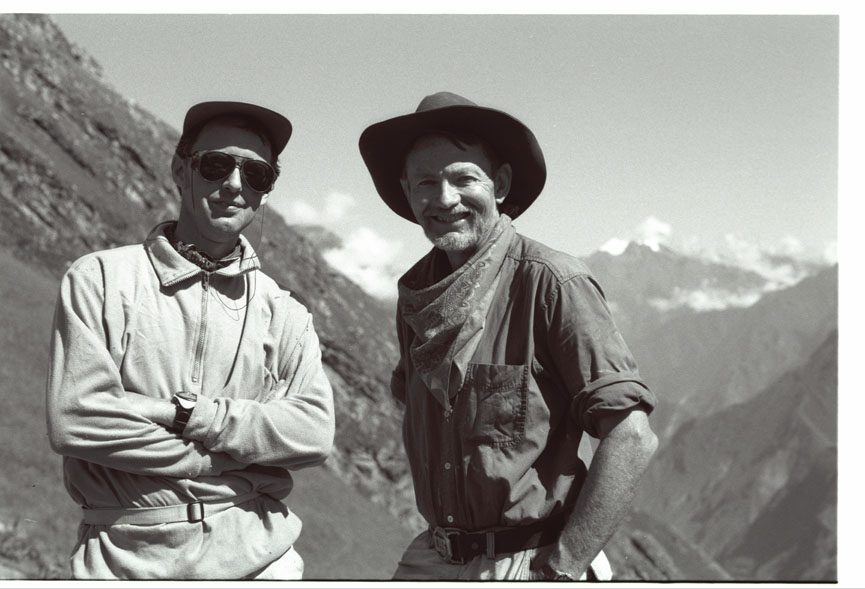
negotiate the difficult mountain roads they could have been slaughtered. Once, years later with the American explorer
Gary Ziegler, I came across a magnificent decayed stairway high up in the
Choquetecarpa valley. The stairway rose out of the grass ahead of us,
seemingly out of nowhere, stone tread after stone tread, a full twelve feet
wide, the width of a royal road – indeed probably the road that the later
Incas may have used when they were in exile in the Vilcabamba after having
fled Cuzco. Even higher in the
valley were some stone llama pens, built just below the pass at a chilling
13,700 feet: circular buildings, thirteen feet in diameter, clustered tightly
together to give protection against the wind. Above, a vertiginous stone
stairway cut its way directly up towards the pass. No travellers now ever
passed along that road – those few that came through would use the modern
mule track instead, which wound its course in a more sedate and European
style over the other shoulder of the pass. We had found this alternate ancient
way because we knew where to look. The Inca instinct for roads is a different
language to our own, but it is one that can be learnt. Click here to read
more... |